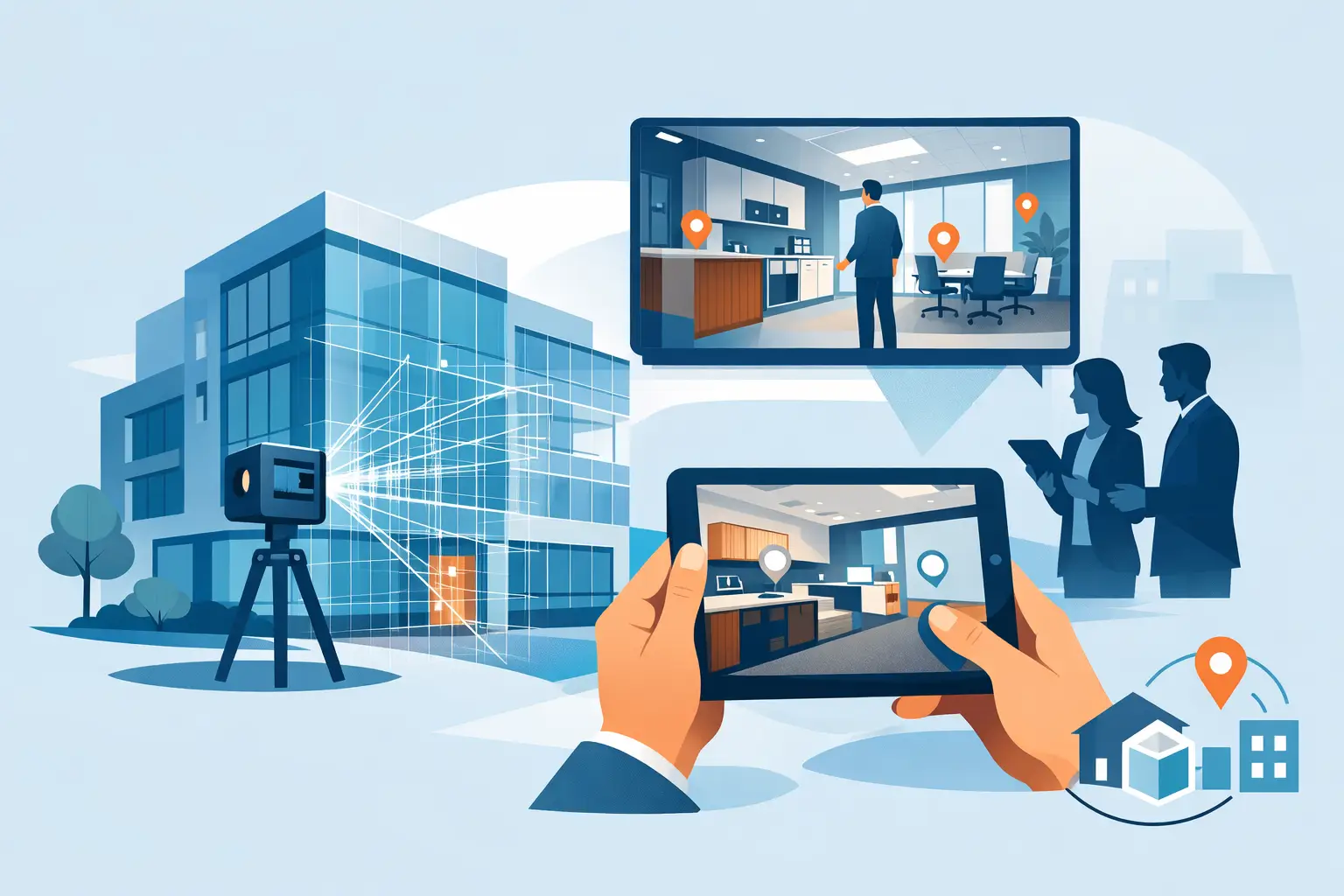

A vacant office floor rarely loses a tenant because of price alone. More often, interest fades earlier – when the listing feels flat, the layout is hard to judge, or the prospect cannot justify an in-person visit yet. That is where matterport for commercial leasing changes the sales process. It gives brokers, landlords, and marketing teams a way to present space with enough context to move a conversation forward before anyone steps on site.
For commercial property, that matters because leasing is usually a multi-stakeholder decision. One person may shortlist the site, another may compare layouts, and another may approve the move based on operational fit. Static photos help at the top of the funnel, but they do not answer the practical questions that slow decisions. How does the reception connect to the work area? Is there a direct route from loading to storage? Does the unit feel narrow, deep, open, or segmented? A digital twin makes those questions easier to answer earlier.
Why matterport for commercial leasing changes lead quality
Commercial leasing teams often focus on lead volume, but quality is where time is won or lost. A digital twin tends to reduce casual inquiries and improve serious ones because prospects can self-qualify before requesting a viewing. They can inspect circulation, room adjacency, frontage, ceiling height perception, and the general feel of the premises in a way photos cannot deliver.
That does not mean every listing needs the same treatment. A small, standard unit in a high-demand location may lease quickly with limited media. But as soon as the space is large, irregular, premium, newly fitted, or difficult to explain, the value of immersive viewing increases. This is especially true for offices, retail lots, showrooms, hospitality venues, and industrial spaces where layout is part of the pitch.
A better-qualified prospect is not just more likely to book a tour. They usually arrive with sharper questions. That shortens explanation time, improves meeting productivity, and gives leasing teams a clearer path to proposal stage.
What a Matterport digital twin actually adds
The common mistake is to think of Matterport as a prettier virtual tour. In commercial leasing, its value is broader than presentation.
First, it creates spatial clarity. A prospect can move through the property at their own pace and understand the relationship between rooms, access points, partitions, and open areas. That is a major advantage when the space will support operations, customer traffic, or staff movement.
Second, it supports remote decision-making. Regional stakeholders, overseas investors, franchise managers, and corporate real estate teams can review the same space without coordinating travel. In markets where cross-border leasing activity is common, this has obvious commercial value.
Third, it becomes a reusable digital asset. Leasing teams can use the same capture across listing campaigns, broker outreach, presentations, and internal approvals. Instead of recreating the story of the property every time, they work from a consistent visual record.
For some properties, the benefit extends beyond leasing. If a tenant is considering fit-out planning, space measurement, or renovation assessment, a well-executed digital twin can support those next-stage conversations more effectively than basic marketing media alone.
Where Matterport works best in commercial leasing
Not every asset performs equally with immersive media, but certain categories benefit more consistently.
Office leasing is a strong example. Decision-makers want to understand openness, meeting room count, breakout areas, reception quality, and how finished the space really is. A digital twin helps distinguish between shell-and-core, partially fitted, and move-in-ready options without overexplaining.
Retail also benefits because frontage, flow, and visibility matter. A tenant evaluating a café, boutique, clinic, or showroom needs more than isolated photos. They need to see how the unit reads from entrance to rear, where display opportunities sit, and whether the footprint aligns with customer movement.
Industrial and warehouse leasing can gain even more from a practical standpoint. Access routes, clear floor areas, loading positions, office attachments, and internal configuration all affect suitability. In these cases, the digital twin works less like a marketing extra and more like a filtering tool for operations-focused prospects.
Hospitality and event spaces are another fit. Venue hire, serviced offices, coworking facilities, and function spaces sell partly on atmosphere and partly on usability. Prospects need both.
The trade-offs leasing teams should understand
Matterport is effective, but it is not magic. If the property is poorly prepared, badly lit, or visibly unfinished in a way that distracts from leasing intent, the scan will capture that reality. In some cases, this honesty is useful because it reduces mismatch. In others, it means teams should stage the space, improve presentation, or wait until a key fit-out milestone is complete.
There is also a positioning decision to make. Some landlords want the digital twin public on the listing. Others prefer to use it only for qualified prospects, especially for premium assets or operational facilities. Both approaches can work. Public access tends to increase engagement and speed early qualification. Controlled access can preserve exclusivity and support a more managed sales process.
Another practical consideration is whether immersive viewing replaces site visits. Usually, it does not. It reduces unnecessary visits and improves the quality of necessary ones. For high-value commercial leasing, tenants still want to inspect the property physically before commitment. The advantage is that by the time they visit, they are often evaluating fit rather than trying to understand the basics.
How to use matterport for commercial leasing effectively
The strongest results come when the digital twin is treated as part of the leasing workflow, not a standalone media item.
Start with the right capture strategy. If the objective is marketing, the scan should emphasize spatial readability and buyer confidence. If the asset also needs support for fit-out planning or documentation, capture quality and coverage become even more important. Large or technically complex environments may benefit from a broader spatial data approach that aligns digital twin output with LiDAR-based workflows and future building documentation needs.
Presentation also matters. A digital twin should sit alongside professional photography, concise leasing information, and a clear next step. The tour answers spatial questions, while the surrounding campaign answers commercial ones such as unit size, availability, terms, intended use, and building advantages.
Leasing teams should then use the asset actively. Send it before calls, attach it in follow-up outreach, use it during stakeholder presentations, and share it with tenant reps who need to circulate options internally. When used this way, the digital twin becomes a decision tool rather than a passive listing feature.
For landlords with multiple units or large portfolios, consistency is where the strategy compounds. Standardized digital presentation across properties improves brand quality, speeds internal coordination, and gives prospects a more reliable comparison experience.
Beyond marketing: operational value after the viewing
One reason commercial decision-makers respond well to digital twins is that the value does not stop at lead generation. Once a prospect becomes serious, the same asset can support discussions around occupancy planning, interior modifications, tenant handover, and stakeholder alignment.
That is especially useful in sectors where several teams evaluate a site at once. Real estate, operations, design, and finance often review different aspects of the same property. A digital twin gives them a shared frame of reference. That reduces the risk of decisions being made from inconsistent photos, memory, or secondhand explanations.
For owners and managers, this also supports continuity. If a leasing campaign rolls into fit-out planning or asset documentation, the transition is smoother when the property has already been captured as a structured digital environment rather than just photographed for advertising.
This is where an experienced implementation partner matters. The output should not just look impressive. It should align with leasing goals, asset type, and the wider digital needs of the property.
A better way to show space before the tour
Commercial leasing has always depended on helping prospects picture themselves in a space. The difference now is that the market expects that process to happen earlier, faster, and with more evidence. Matterport for commercial leasing meets that expectation when it is used with clear commercial intent.
It helps serious prospects understand the property sooner, helps leasing teams spend time where it counts, and helps stakeholders make decisions without waiting for perfect scheduling. For landlords and brokers competing in crowded markets across Southeast Asia, that is not just a presentation upgrade. It is a practical advantage in how space gets leased.
The best digital property assets do not replace good leasing work – they make it easier for the right tenant to see the value you are already trying to explain.