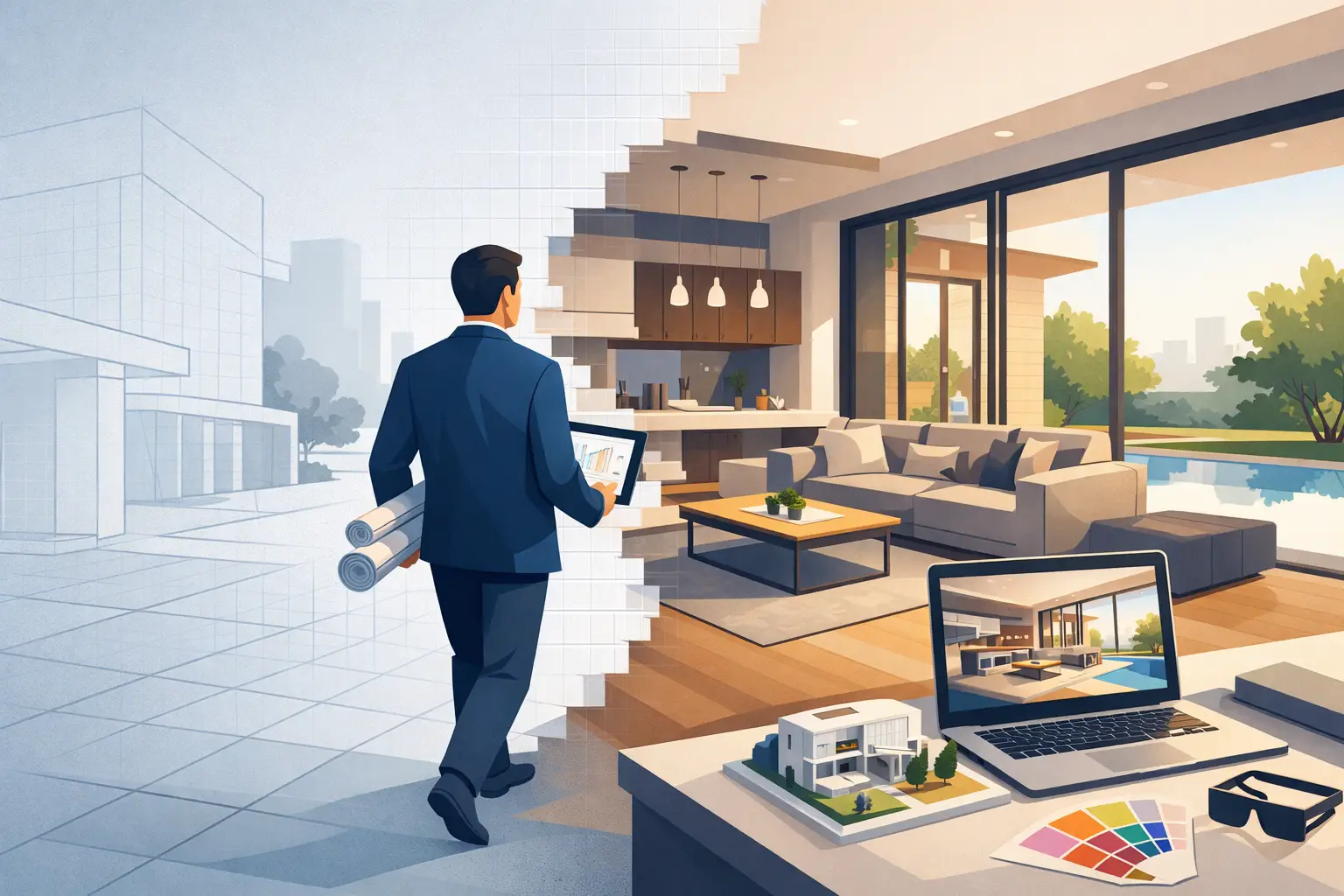

A brochure can describe a future building. A floor plan can explain it. But when investors, buyers, tenants, or internal stakeholders need to feel confident about a project that does not exist yet, those tools usually stop short. A CGI walkthrough for unbuilt projects closes that gap by turning drawings, models, and design intent into a visual experience people can actually understand.
That matters because most project decisions are not delayed by missing data alone. They are delayed by uncertainty. When a stakeholder cannot picture circulation, scale, lighting, sightlines, or how one space connects to another, approval slows down, marketing underperforms, and sales teams end up compensating with long explanations.
Why a CGI walkthrough for unbuilt projects works
The value of a CGI walkthrough is not just visual polish. It is translation. It converts technical design information into a format that is usable by non-technical audiences without stripping away the detail that matters.
For developers and property marketers, that means a future asset can be presented before construction is complete. For architects and consultants, it means design intent is easier to communicate to clients who do not read plans every day. For hospitality, retail, and commercial leasing teams, it means the experience of a space can be sold earlier and more convincingly.
Static renderings still have a role, especially for hero views and campaign materials. But they frame a single moment. A walkthrough frames a journey. That difference matters when the project depends on helping someone understand arrival, movement, adjacency, and atmosphere.
In practical terms, a good walkthrough can reduce repetitive explanation during presentations, improve stakeholder alignment, and shorten the time between interest and action. It gives commercial teams a stronger sales tool and gives project teams a clearer communication asset.
What decision-makers actually gain
A CGI walkthrough for unbuilt projects helps different teams solve different problems, which is why it tends to perform best when it is planned as a business asset rather than a design add-on.
For sales and marketing teams, the biggest gain is clarity. Prospects can grasp the offering faster, especially in mixed-use developments, hospitality venues, premium residences, and large commercial spaces where the user experience is part of the value proposition. Instead of describing how the lobby connects to shared amenities or how a retail frontage feels from the approach, the walkthrough shows it.
For project stakeholders, the gain is alignment. It becomes easier to discuss design choices, identify friction points, and secure approvals when everyone is reacting to the same visual narrative. This is particularly useful when decision-makers are distributed across offices or countries and cannot easily review physical mockups.
For investors and partners, the gain is confidence. A clearer representation of the final outcome often improves presentation quality during fundraising, leasing, or pre-launch activity. It does not replace feasibility, numbers, or technical documentation, but it does help those conversations land more effectively.
What makes a walkthrough credible instead of just attractive
There is a meaningful difference between a cinematic animation and a commercially useful CGI walkthrough. The first may look impressive. The second needs to support decision-making.
Credibility starts with source material. The strongest walkthroughs are built from accurate architectural drawings, BIM models, material schedules, and spatial planning data. If the input is inconsistent, the output may still look beautiful, but it risks creating false expectations. That is where technical discipline matters.
Camera logic also matters. A walkthrough should reflect how a person would actually move through the space. Unrealistic transitions, dramatic flight paths, or overly stylized motion can weaken comprehension. If the goal is to help a buyer understand a condominium unit, or help a tenant visualize a commercial floor plate, realism usually beats spectacle.
Lighting, scale, and finishes are another balancing act. Early-stage projects may not have every specification finalized, so some assumptions will be necessary. The key is to distinguish between elements that are fixed and elements that remain indicative. A useful provider will advise where precision is essential and where visual interpretation is acceptable.
When to produce a CGI walkthrough for unbuilt projects
Timing depends on what the walkthrough needs to achieve. If the objective is early investor presentation, a conceptual version may be enough, provided massing, layout, and brand direction are already established. If the objective is public-facing marketing, then materials, furniture, landscaping, and occupancy styling need far greater refinement.
There is no single perfect stage. Produce it too early and you risk revisions as the design evolves. Produce it too late and the commercial window for pre-sales, leasing, or stakeholder engagement may have narrowed.
In most cases, the best approach is phased. An initial version can support internal approvals or soft-launch conversations, followed by a more detailed version once the design package stabilizes. This protects budget while keeping the visualization useful across the project lifecycle.
Where CGI walkthroughs create the most value
Real estate is the obvious use case, but it is far from the only one. In residential development, walkthroughs help buyers understand unit flow, amenity access, and overall project positioning before the site is complete. In commercial real estate, they support leasing by showing circulation, frontage, fit-out potential, and shared spaces.
In hospitality, they are especially effective because guest experience is spatial and emotional. A hotel, resort, or serviced residence is rarely sold on floor area alone. It is sold on arrival sequence, atmosphere, views, public areas, and room experience. CGI walkthroughs communicate those layers more effectively than plans and stills.
For AEC teams, the value often sits in stakeholder communication rather than marketing. A walkthrough can support planning presentations, client reviews, and design coordination discussions. It can also sit alongside digital twin and Scan-to-BIM workflows where future-state visualization and existing-condition data need to work together.
In retail, exhibitions, and branded environments, the payoff is often speed. Internal teams, brand managers, and partners can validate layouts and customer journeys earlier, which reduces ambiguity before fabrication or fit-out begins.
What clients should prepare before commissioning one
The quality of the output depends heavily on the quality of the brief. That does not mean every finish and fixture must be finalized, but the strategic purpose must be clear.
A provider should know who the walkthrough is for, what decision it needs to support, and where it will be used. A leasing presentation, website launch, investor pitch, and social campaign all place different demands on pacing, detail, and output format.
It also helps to define what must be accurate versus what can remain illustrative. Structural geometry, view corridors, and core layouts may be fixed. Decorative styling, planting maturity, or some finish choices may still be under review. Establishing that boundary early prevents rework and protects credibility.
Projects with stronger technical foundations generally move faster. Accurate plans, coordinated 3D models, reference imagery, brand guidelines, and material intent all improve the result. If those inputs are fragmented, the visualization team may need to spend extra time resolving conflicts before production even begins.
Common mistakes that reduce ROI
The first mistake is treating the walkthrough as a last-minute marketing extra. If it is brought in too late, there is less room to align it with campaign strategy, stakeholder needs, or project milestones.
The second is overproducing style and underproducing clarity. Dramatic music, cinematic angles, and glossy effects can create impact, but if the audience still cannot understand the space, the asset has missed its commercial job.
The third is ignoring revision reality. Unbuilt projects change. A professional workflow anticipates this with clear approval stages, version control, and practical assumptions about what may evolve.
The fourth is failing to connect the walkthrough to a broader digital ecosystem. Its value increases when it supports other tools such as landing pages, virtual showrooms, digital twins, sales presentations, and remote stakeholder reviews.
Choosing the right production partner
A strong visual team should not only render well. It should understand buildings, workflows, and business outcomes. That means asking better questions about audience, use case, accuracy level, and integration with the rest of the project stack.
For more technical projects, experience with spatial data, BIM, and real-world capture workflows can be a real advantage. It helps ensure the visualization is grounded in buildable logic rather than pure aesthetics. That becomes even more relevant on complex developments, phased assets, or projects involving multiple stakeholders across design, construction, and commercial functions.
The best partnerships are consultative. They help clients decide what kind of walkthrough is appropriate, what level of detail is commercially justified, and how to produce an asset that remains useful beyond a single presentation.
Novo Reperio approaches this as part of a larger spatial visualization strategy, where CGI, digital twins, 3D capture, and immersive presentation tools can work together rather than in isolation.
A well-executed walkthrough does more than make an unbuilt project look finished. It helps people decide, commit, and move forward with fewer assumptions. That is usually where the real return begins.