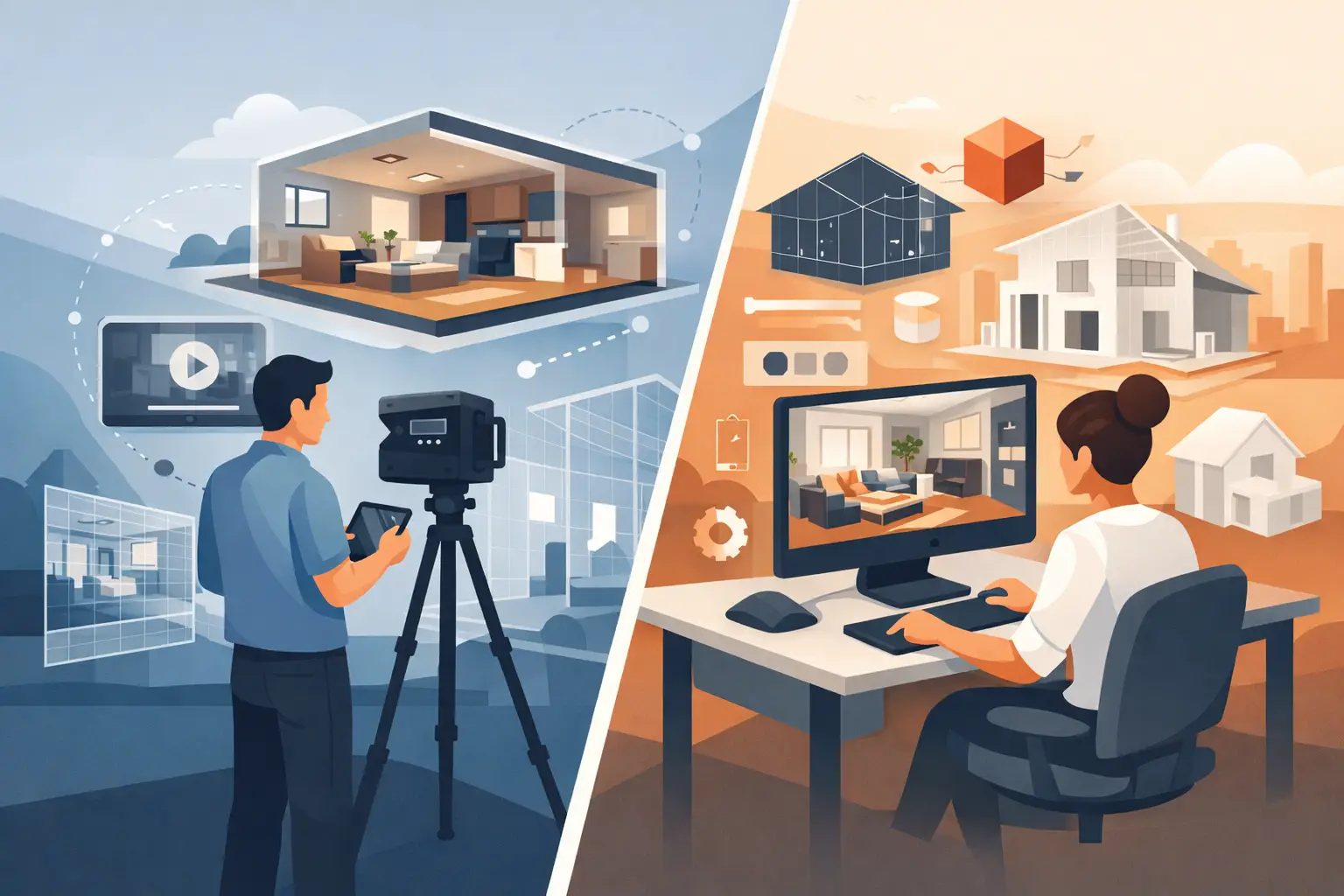

When a sales team needs a space online next week, the matterport vs cgi walkthrough decision stops being a creative discussion and becomes a commercial one. One option captures what already exists with speed and spatial accuracy. The other builds what does not yet exist, with full control over every finish, lighting condition, and camera move. The right choice depends less on trend and more on what the asset needs to achieve.
For developers, hotel operators, brokers, and facility stakeholders, this choice affects more than visual presentation. It shapes how quickly you can launch, how confidently buyers can assess a space remotely, and how effectively your digital asset supports marketing, leasing, planning, or stakeholder approval. That is why the comparison should start with business use, not software preference.
Matterport vs CGI walkthrough: the core difference
Matterport is a capture-based digital twin. A camera scans a real, physical environment and turns it into an interactive 3D experience. Users can move through the space, understand layout, and inspect real-world conditions. Because it is based on actual spatial capture, it is well suited to built environments where accuracy and documentation matter.
A CGI walkthrough is a computer-generated visualization. It is created from drawings, BIM models, design references, or concept files. Instead of documenting what is there, it presents what is planned, proposed, renovated, or idealized. That makes it valuable when the physical asset is unfinished, under construction, or not yet built.
This sounds straightforward, but the trade-off is where decisions get more nuanced. Matterport gives you speed and truth. CGI gives you control and possibility.
When Matterport is the stronger choice
Matterport performs best when the space already exists and the goal is to help people understand it remotely with minimal friction. In commercial real estate, this often means office floors, retail units, showrooms, hospitality venues, and completed residential properties. Prospects can explore the space on their own schedule, and internal teams can use the same asset for coordination, review, or documentation.
The biggest advantage is credibility. What viewers see is the real environment, not a stylized interpretation. That matters when a leasing team wants to reduce unnecessary site visits, when an owner wants to show actual fit-out condition, or when a facility manager needs a digital reference point for operations.
Matterport also has a speed advantage in many live projects. Once the site is ready to scan, capture and processing are typically faster than commissioning a fully custom animation pipeline. If your marketing timeline is tight, or if you need to publish a digital twin shortly after completion, this can be the more efficient route.
For sectors like AEC, insurance, restoration, and facility management, the value extends beyond marketing. A capture-based model can support as-built review, remote stakeholder alignment, and a stronger record of site condition. In those cases, the visual experience is only one part of the return.
Still, Matterport has limits. It can only capture what physically exists. If the lighting on the day is poor, if a unit is unfinished, or if the space needs to reflect a future design state, the digital twin will not solve that gap on its own. It is truthful, but not flexible in the way previsualization often demands.
When a CGI walkthrough is the better investment
A CGI walkthrough becomes more valuable when the real asset cannot yet be shown, or should not be shown in its current state. Developers selling off-plan units, hotels marketing future renovations, and retail brands pitching concept environments often need a visual asset before construction is complete. That is where CGI leads.
With CGI, every visual element can be controlled. Materials, furniture, daylight, weather, landscaping, occupancy, and camera choreography can all be tailored to the audience and objective. If you need to present multiple unit variations, branded interiors, or a future amenity deck that exists only in drawings, CGI can communicate that vision far more effectively than a scan of a construction site.
This flexibility also makes CGI useful for premium positioning. Luxury property, hospitality launches, and investor presentations often require a level of polish that goes beyond documentation. A well-produced CGI walkthrough can frame the experience, not just the geometry. It can emphasize arrival sequence, highlight design intent, and shape perception before the first site visit happens.
But CGI brings its own constraints. It requires more upfront planning, creative coordination, and review cycles. If source files are incomplete or decisions on finishes are still changing, production can stretch. There is also a risk of overpromising if the final built result diverges too far from the visualization. For commercially sensitive projects, that gap needs to be managed carefully.
Matterport vs CGI walkthrough for marketing outcomes
If the objective is lead generation for a completed property, Matterport often has the stronger practical advantage. It reduces viewer uncertainty because it presents the actual space. Prospects can self-qualify faster, sales teams spend less time answering basic layout questions, and remote buyers gain a clearer basis for decision-making.
If the objective is pre-launch marketing, investor communications, or premium storytelling around an unbuilt asset, CGI is usually the stronger tool. It helps sell the outcome before the outcome exists. In competitive property markets, that can shorten the path from concept to buyer interest.
The key is to match the format to the sales stage. A completed warehouse in Johor available for immediate lease benefits from an accurate digital twin. A branded residence in Kuala Lumpur still under development may need a CGI walkthrough to create confidence and momentum before handover.
Cost, timeline, and scalability
Budget questions usually come early in the matterport vs cgi walkthrough conversation, but cost only makes sense when measured against use case. Matterport is often more cost-efficient for existing spaces, especially when speed matters and the goal is broad usability across marketing and operations. One capture session can produce a reusable digital asset for leasing, internal review, and stakeholder sharing.
CGI is generally more resource-intensive because it is built scene by scene. Modeling, texturing, lighting, revisions, and animation all take time. However, for pre-construction projects, there may be no viable alternative if you need a compelling walkthrough before the space exists.
Scalability also differs. Matterport can be deployed across multiple built sites with relative consistency, which is useful for hotel groups, coworking operators, retail chains, and industrial portfolios. CGI can scale too, but it usually requires more bespoke work per environment unless there is a highly standardized design system.
Accuracy vs aspiration
This is where many decision-makers get stuck. Matterport wins on recorded reality. CGI wins on designed intent. Neither is universally better.
If your stakeholders need to verify dimensions, understand actual circulation, or assess current site condition, reality matters more than visual drama. If your stakeholders need to buy into a future state, secure approvals, or emotionally connect with a concept, aspiration matters more than current conditions.
In practice, many high-performing campaigns use both at different points. A developer may launch with CGI during pre-sales, then transition to Matterport once the show unit or completed space is ready. A hotel may use CGI for renovation previews and Matterport for the finished venue. This is often the strongest strategy because it aligns the asset with the project lifecycle instead of forcing one format to do every job.
How to choose without wasting budget
Start with a simple question: are you trying to show what exists, or sell what is planned?
If the asset already exists and remote exploration, documentation, or operational visibility are priorities, Matterport is usually the more effective investment. If the asset is unbuilt, incomplete, or needs a controlled narrative for launch, CGI is often the right move.
Then look at your timeline. If speed to market matters, capture-based workflows have a clear advantage. If visual control and future-state storytelling matter more, the additional production time in CGI may be justified.
Finally, consider how the asset will be used after launch. A digital twin can continue supporting facilities, training, inspections, and as-built reference long after the first marketing push. A CGI walkthrough is strongest when its role is persuasion, positioning, and pre-completion engagement.
For most commercial teams, this is not really a technology decision. It is a decision about sales stage, asset readiness, and what kind of confidence your audience needs before they act. Choose the format that reduces uncertainty fastest, because that is usually where the return shows up first.