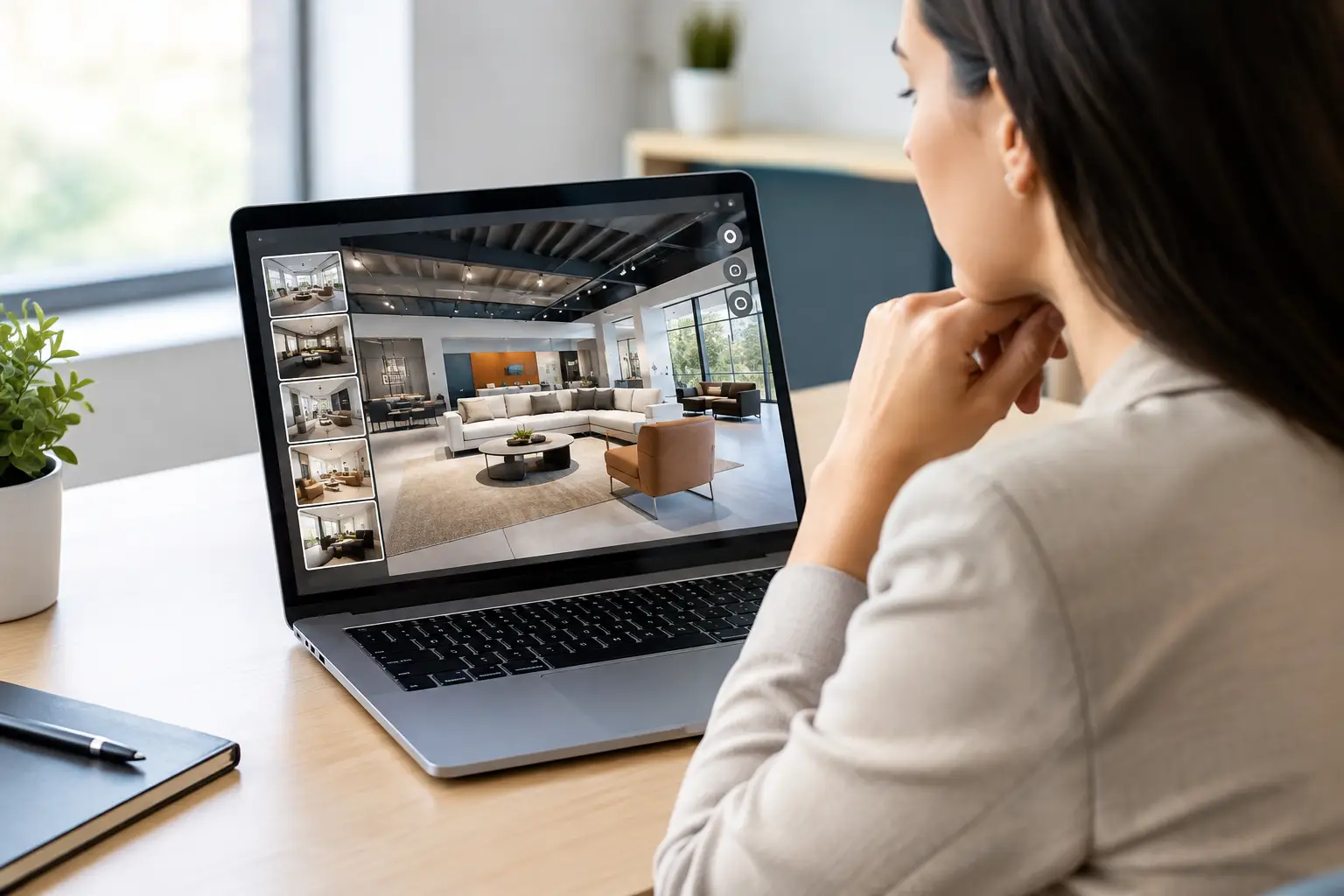

A virtual showroom can be a straightforward 360-degree walkthrough, a shoppable product environment, or a data-rich digital twin connected to sales, inventory, and marketing systems. That range is why virtual showroom costs vary considerably. The useful question is not simply, “What does it cost?” but “What must this experience help the business achieve?”
For a property developer, the priority may be giving overseas buyers a credible way to explore a sales gallery before booking a viewing. For a retailer or automotive brand, it may be guiding customers from product discovery to inquiry. For a venue operator, the value may come from helping event planners assess room layouts remotely. The right investment is tied to the commercial job the showroom needs to perform.
The Main Factors Behind Virtual Showroom Costs
The first cost driver is the size and complexity of the physical space. A compact retail suite with a defined route through a small number of products requires less capture, production, and quality assurance than a multi-floor showroom, hotel, convention venue, or industrial facility. Large spaces also create decisions around navigation, loading performance, and the level of detail required in each area.
Capture method matters as much as floor area. A basic 360 virtual tour may be appropriate when the goal is visual access and rapid publication. Matterport digital twin capture adds spatial understanding, dollhouse-style navigation, measurements, and a more structured representation of the environment. LiDAR-based capture and advanced 3D spatial mapping are more relevant where a showroom asset will also support as-built documentation, facility planning, or future Scan-to-BIM workflows.
This is an area where choosing the lowest initial price can create an expensive limitation later. If the space will be renovated regularly, used by operations teams, or referenced by multiple stakeholders, a more accurate spatial capture can deliver value beyond marketing. If the experience is only required for a short campaign, a lighter production model may be the more commercially sensible choice.
Existing space, planned space, or both
A showroom that already exists can be captured through photography, 360 imagery, LiDAR scanning, or digital twin technology. A showroom that has not yet been built requires a different production process: 3D modeling, CGI rendering, material visualization, lighting design, and a walkthrough built from architectural drawings, BIM models, or design files.
CGI showroom projects usually require more time in pre-production because every visible component must be modeled or validated. The benefit is control. Teams can present an unbuilt sales gallery, retail concept, unit interior, or exhibition layout before physical construction is complete. They can also produce multiple design options without the disruption or cost of staging each version on site.
Hybrid projects can be particularly effective. For example, an existing development gallery can be captured as a digital twin while planned units, amenities, or future phases are presented through integrated CGI scenes. This gives prospects an honest view of what exists now and a compelling preview of what is coming next.
Interactivity and sales functionality
The viewing experience itself is only one layer of a virtual showroom. Costs increase as the environment becomes more interactive, but the right interactions can turn passive interest into qualified action.
A basic experience may include branded navigation, labels, and contact details. A more developed showroom can add clickable product hotspots, specification sheets, image galleries, videos, floor plans, booking forms, lead capture, downloadable brochures, and direct inquiry prompts. Retail environments may require product-level calls to action, while hospitality and event venues may benefit from capacity information, layout galleries, and virtual inspection routes for planners.
Custom functionality should be selected carefully. A hotspot for a high-value product line or a booking prompt at a decisive point in a property tour can justify its production cost. Adding interactions simply because they are possible can make the experience harder to navigate and more difficult to maintain. The best interface helps visitors answer practical questions without pulling them away from the space.
Virtual Showroom Costs: Budget by Business Objective
Budgeting works better when projects are framed around outcomes rather than a generic package. A marketing-focused showroom is built to increase reach, dwell time, inquiries, and viewing confidence. An operational showroom or digital twin may need higher spatial accuracy, documentation, asset information, and access controls. A sales environment for a premium development, yacht, or automotive brand may place greater weight on visual polish, cinematic media, and brand-specific interaction design.
A useful scope discussion starts with five areas:
- The number, size, and condition of spaces to be represented
- Whether the environment will be captured, rendered from plans, or delivered as a hybrid
- The level of visual fidelity and the media required, including photography, video, drone imagery, and CGI
- The actions visitors should be able to take, such as inquire, book, compare, or purchase
- The intended lifespan of the asset and how often content, products, or layouts will change
These decisions affect production effort in different ways. A polished digital showroom with limited functionality may cost more than a basic tour with extensive tagging because high-end photography, CGI, styling, and post-production are specialist tasks. Conversely, a large but visually simple facility may require more work in scanning, data organization, and platform configuration than in creative production.
For businesses operating across Malaysia, Singapore, Indonesia, or Thailand, logistics may also influence scope. Multiple sites, travel, access requirements, after-hours capture, site safety coordination, and brand consistency across locations should be planned from the beginning rather than treated as last-minute additions.
One-Time Production vs. Ongoing Costs
Virtual showroom budgets are often discussed as a single production fee, but the full cost of ownership includes more than capture and launch. Hosting, platform subscriptions, domain or website integration, analytics configuration, content updates, and technical support may continue after publication.
This does not mean every project needs a long-term support agreement. A campaign-based showroom with stable content may need little beyond hosting and occasional updates. A retail showroom with seasonal displays, changing stock, or frequent promotions benefits from a clear update process. A facility model used for training, maintenance, or project coordination may need formal user management and ongoing data governance.
Ask early who will own the source files, who can update the experience, and what happens when the platform, product range, or physical space changes. These details protect the useful life of the asset. They also make it easier to compare proposals that may appear similar at launch but have very different maintenance requirements.
The cost of a weak brief
The most avoidable expense is not necessarily a premium capture method or custom development. It is rework caused by an unclear brief. When stakeholders have not agreed on audience, navigation, brand standards, lead goals, approval process, or technical requirements, changes tend to arrive after production is underway.
Before commissioning a virtual showroom, define the audience’s next action. A buyer may need to schedule a viewing. A dealer may need product information. A facilities manager may need an accurate spatial reference. Once that action is clear, it becomes easier to decide what must be captured, rendered, tagged, or integrated – and what can be left out.
How to Evaluate Return, Not Just Price
A virtual showroom should be measured against the friction it removes. Does it allow remote prospects to qualify themselves before a physical appointment? Does it help a sales team explain layout, finishes, and product features consistently? Does it extend the usefulness of a physical space beyond opening hours? Does it reduce repeated site visits for stakeholders who only need an initial assessment?
The most relevant metrics depend on the sector. Property and hospitality teams may track inquiry quality, time spent exploring, direct booking activity, and viewing-to-lead conversion. Retail and automotive teams may monitor product interactions, brochure downloads, appointment requests, and campaign performance. Industrial and facility teams may evaluate time saved locating information, reduced travel, faster planning, or improved communication with contractors.
There is also a brand consideration. In high-consideration purchases, static photography rarely answers enough questions on its own. An immersive environment gives buyers a better sense of scale, flow, context, and finish. That confidence can shorten the distance between initial interest and a meaningful sales conversation.
Building a Scope That Stays Commercially Sound
The best way to control virtual showroom costs is to separate essential requirements from future enhancements. Start with the locations, views, and information that directly support the first business objective. Then build the experience on a platform and capture standard that can accommodate later additions, such as new hotspots, updated media, extra spaces, or operational data.
Novo Reperio approaches this work as a spatial asset strategy, not just a visual deliverable. The capture method, interactive layer, website connection, and future data use should be considered together, particularly when a space has value across marketing, sales, and operations.
A well-scoped virtual showroom does not need every available feature. It needs enough visual credibility, spatial clarity, and purposeful interaction to help the right person make the next decision with confidence.